We typically imagine that two things don’t influence each other because space separates them: Flares from alien stars are far away, and that’s why they don’t knock out power on Earth. But it from qubit suggests we have it backward. Perhaps space seems to separate two things precisely because they don’t influence each other. Consider a video game sun passing behind a video game tree. The sun pixels touch the tree pixels directly, yet the tree does not burst into flames. This is because the sun pixels are independent of the tree pixels. Their independence is what makes the sun “far” from the tree.
Brawler by Lauren Groff
Lunch at the Hirshhorn
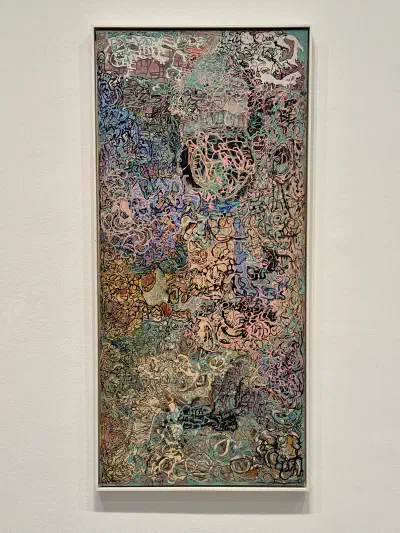
[Sobel] was noted by acclaimed gallerist Sidney Janis for her self invented method for applying paint, the very same method of drip painting that went on to influence some of the most famous names of the abstract expressionist movement. […] In 1947, Sobel faded from the spotlight, and the following year, after discovering an allergy to paint, she turned to crayon and pencil. It took until the late 1960s for her name to resurface, with MoMA’s acquisition of Milky Way, but she died soon after, in 1968.
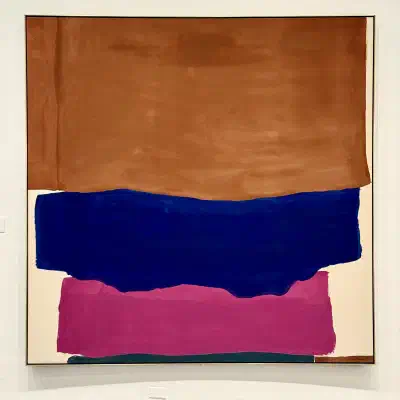
A really good picture looks as if it’s happened at once. It’s an immediate image. For my own work, when a picture looks labored and overworked, and you can read in it—well, she did this and then she did that, and then she did that—there is something in it that has not got to do with beautiful art to me. And I usually throw these out, though I think very often it takes ten of those over-labored efforts to produce one really beautiful wrist motion that is synchronized with your head and heart, and you have it, and therefore it looks as if it were born in a minute.
Hotel breakfast
Hotel breakfast is the creation of the universe. Entropy is low: Everyone there has slept on the same mattress, watched the same Friends reruns, searched for the same impossible-to-reach outlet hidden behind the same nicked-up furniture. Everyone smells of the same wall-mounted shampoo and body wash.
At 8:50am they file in. Spread out before them is the same half-hearted food they expected but still dread—and yet will accept. Gingerly they take what they must. Energy is building. Coffee. Powdered eggs. Cheerios. Subtitled local news plays on the TV, keeping things at a low simmer.
Then the big bang. The stars of this universe fling outwards: conference goers, presentation givers, tour bus riders, wedding attendees. Stored energy is burned. A city is formed. States, nations, planets are considered; imagination does the rest. By afternoon, expansion has reached its maximum and gravity begins—slowly, gently—to pull everyone back. “Maybe tomorrow I’ll try that coffee shop around the corner,” everyone thinks as they walk through the lobby back towards their room.
No. They will not. The universe must be created anew each day.
Ordinary abundance
Like lovers' kisses, she biteth — she is a pleasure bordering on pain from the fierceness and insanity of her relish.
Charles Lamb, 1822 — On the rapture of the pineapple. In eighteenth-century Britain, a pineapple was costly enough that hostesses sometimes rented one for the evening rather than eat it.
I should have seen this coming
David Brooks:
If there is an underlying philosophy driving Trump, it is this: Morality is for suckers. To borrow from Thucydides, the strong do what they want, and the weak suffer what they must. This is the logic of bullies everywhere. And if there is a consistent strategy, it is this: Day after day, the administration works to create a world where ruthless people can thrive.
Time and time again, we hear from people who are somehow surprised by the nihilism of this administration—even though Trump’s moral failure has been on proud display since the very beginning. Brooks has always opposed Trump, but our current slow and steady decline into dysfunction should not shock: it is a desired and concerted outcome.
When Trump creates an unnecessary crisis, it’s unlikely to be a small one. The proverbial “adults in the room” who contained crises in Trump’s first term are gone. Whatever the second-term crisis—runaway inflation? a global trade war? a cratered economy and plummeting stock market? an out-of-control conflict in China? botched pandemic management? a true hijacking of the Constitution precipitated by defiance of the courts?—it is likely to crater his support and shift historical momentum.
I’m not sure I share Brooks’s certainty that “Trumpism” (an empty term if there ever was one) is doomed to fail. The ingredients for authoritarianism are available and ripening: a power-obsessed executive branch, an activist and enabling Supreme Court, an ineffectual and dithering Congress. Now is not the time to hide and await the promised renaissance. It must be earned by continually advocating for a return to governing on shared morals and decency.
Mudlarks by Mary Helen Specht
A history of menus is a menu of history
A menu describes what a restaurant serves—but a menu also describes who is being served.
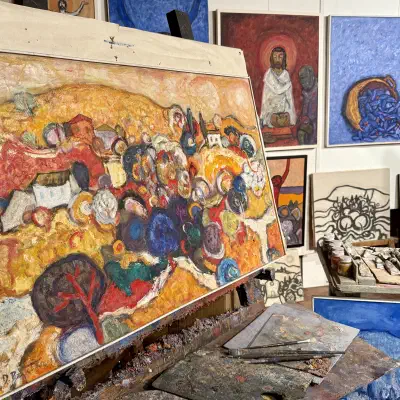
Studio of Ðuro Pulitika
King Ropes
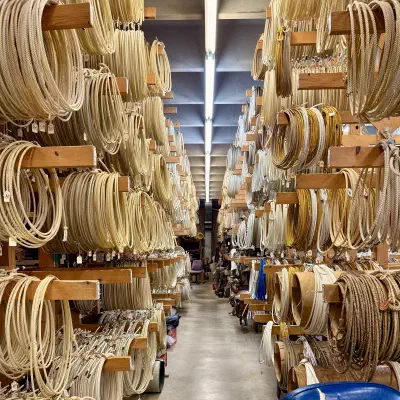
The Brinton Museum
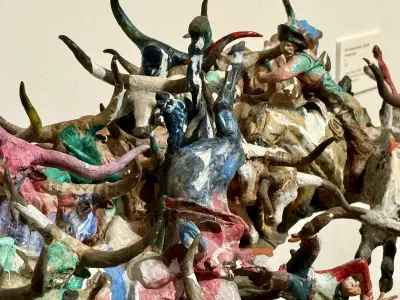
The Brinton Museum is built into a hillside outside Sheridan, Wyoming, and overlooks the Bighorn Mountains. The entrance feels like a portal to some interior place—or maybe an extension of that interior place as it tries to emerge from the earth.
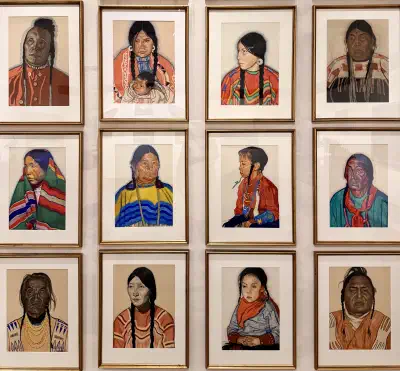
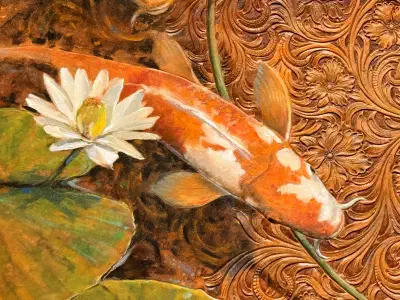
Inside is a striking collection of indigenous and Western art, including: recollections and paintings of The Battle of the Greasy Grass / Little Bighorn; Winold Reiss’s Montana Blackfeet portraits, each with their own story to tell; and Jim Jackson’s paintings on carved leather.
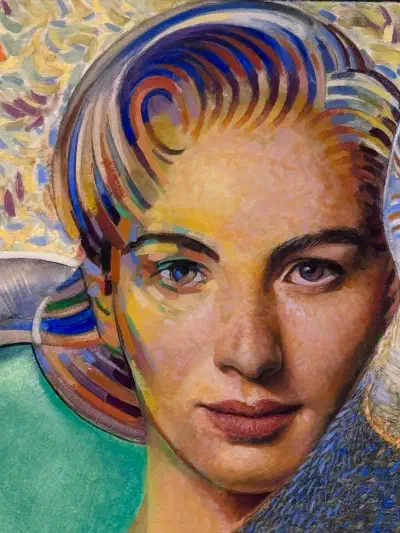
The 100 best novels of all time theguardian.com
From Eternity to Here by Sean Carroll
Martyr! by Kaveh Akbar
Nahwa
Nahwa is a territory that forms part of the Emirate of Sharjah in the United Arab Emirates. It is a counter-enclave (or second-order enclave) within the Omani territory of Madha, which is itself an exclave of Oman and an enclave within the United Arab Emirates.
Big Jim Collie’s Braemar crossing

He starts the day as he means to continue, with a wee dram.
Emerald Lake reflection
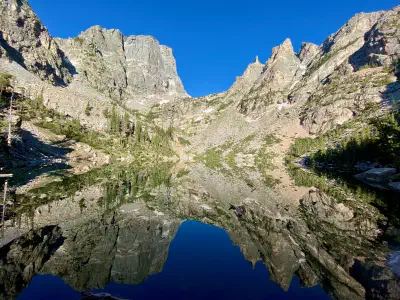
Arriving in complete stillness at Emerald Lake.
The Last Samurai by Helen DeWitt
James by Percival Everett
For the first time in my life, I had paper and ink. I was beside myself. I found a straight stick and shaved it to a point and scratched a groove on one side. I put the paper on my lap, dipped my stick into the ink and wrote the alphabet. I printed letters as I had seen them in books, slowly, clumsily. Then I wrote my first words. I wanted to be certain that they were mine and not some I had read from a book in the judge’s library. I wrote:
I am called Jim. I have yet to choose a name.
In the religious preachings of my white captors I am a victim of the Curse of Ham. The white so-called masters cannot embrace their cruelty and greed, but must look to that lying Dominican friar for religious justification. But I will not let this condition define me. I will not let myself, my mind, drown in fear and outrage. I will be outraged as a matter of course. But my interest is in how these marks that I am scratching on this page can mean anything at all. If they can have meaning, then life can have meaning, then I can have meaning.
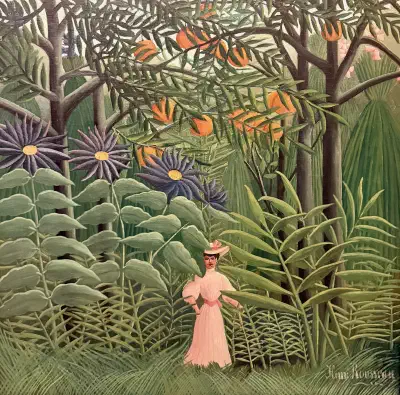
Woman Walking in an Exotic Forest by Henri Rousseau