For the first time in my life, I had paper and ink. I was beside myself. I found a straight stick and shaved it to a point and scratched a groove on one side. I put the paper on my lap, dipped my stick into the ink and wrote the alphabet. I printed letters as I had seen them in books, slowly, clumsily. Then I wrote my first words. I wanted to be certain that they were mine and not some I had read from a book in the judge’s library. I wrote:
I am called Jim. I have yet to choose a name.
In the religious preachings of my white captors I am a victim of the Curse of Ham. The white so-called masters cannot embrace their cruelty and greed, but must look to that lying Dominican friar for religious justification. But I will not let this condition define me. I will not let myself, my mind, drown in fear and outrage. I will be outraged as a matter of course. But my interest is in how these marks that I am scratching on this page can mean anything at all. If they can have meaning, then life can have meaning, then I can have meaning.
Books
Mudlarks by Mary Helen Specht
From Eternity to Here by Sean Carroll
Martyr! by Kaveh Akbar
The Last Samurai by Helen DeWitt
James by Percival Everett
Interior Chinatown by Charles Yu
“For my friend Fong,” he says, and begins singing John Denver. If you didn’t know it already, now you do: old dudes from rural Taiwan are comfortable with their karaoke and when they do karaoke for some reason they love no one like they love John Denver.
Maybe it’s the dream of the open highway. The romantic myth of the West. A reminder that these funny little Orientals have actually been Americans longer than you have. Know something about this country that you haven’t yet figured out. If you don’t believe it, go down to your local karaoke bar on a busy night. Wait until the third hour, when the drunk frat boys and gastropub waitresses with headshots are all done with Backstreet Boys and Alicia Keys and locate the slightly older Asian businessman standing patiently in line for his turn, his face warmly rouged on Crown or Japanese lager, and when he steps up and starts slaying “Country Roads,” try not to laugh, or wink knowingly or clap a little too hard, because by the time he gets to “West Virginia, mountain mama,” you’re going to be singing along, and by the time he’s done, you might understand why a seventy-seven-year-old guy from a tiny island in the Taiwan Strait who’s been in a foreign country for two-thirds of his life can nail a song, note perfect, about wanting to go home.
Intermezzo by Sally Rooney
Things Fall Apart by Chinua Achebe
The Order of Time by Carlo Rovelli
Our “present” does not extend throughout the universe. It is like a bubble around us.
How far does this bubble extend? It depends on the precision with which we determine time. If by nanoseconds, the present is defined only over a few meters; if by milliseconds, it is defined over thousands of kilometers. As humans, we distinguish tenths of a second only with great difficulty; we can easily consider our entire planet to be like a single bubble where we can speak of the present as if it were an instant shared by us all.
So Late in the Day by Claire Keegan
‘Is there anything you would not give me?’ she had once asked.
‘Nothing,’ he had said, instantly. ‘There is nothing.’
For some reason, she had kept looking at him, and had waited.
‘Well,’ he had said, clearing his throat. ‘Maybe the land. I wouldn’t want to give you the land.’
Dept. of Speculation by Jenny Offill
A student asked Donald Barthelme how he might become a better writer. Barthelme advised him to read through the whole history of philosophy from the pre-Socratics up through the modern-day thinkers. The student wondered how he could possibly do this. “You’re probably wasting time on things like eating and sleeping,” Barthelme said. “Cease that, and read all of philosophy and all of literature.” Also art, he amended. Also politics.
You Dreamed of Empires by Álvaro Enrigue
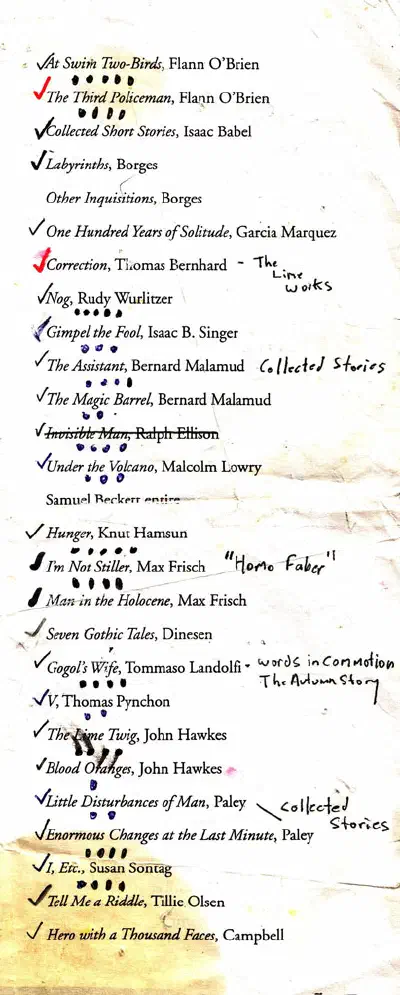
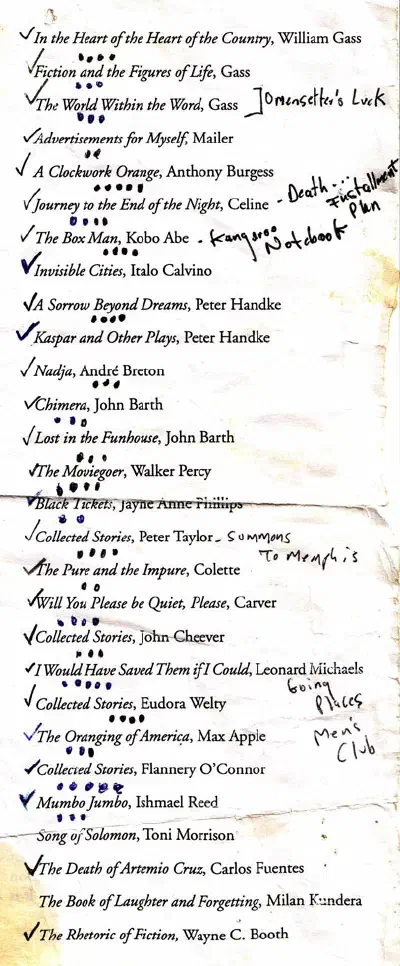
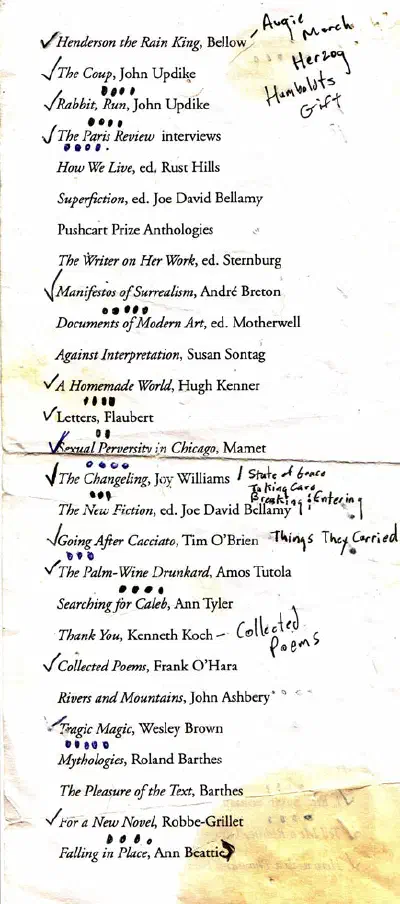
The Barthelme Syllabus
Kevin Moffett in The Believer:
Then, in my last year of college in Gainesville, Florida, I was given secondhand a list of eighty-one books, the recommendations of Donald Barthelme to his students. Barthelme’s only guidance, passed on by Padgett Powell, one of Barthelme’s former students at the University of Houston and my teacher at the time, was to attack the books “in no particular order, just read them,” which is exactly what I, in my confident illiteracy, resolved to do.
I had heard of this syllabus and was thrilled that someone had preserved it. As Moffett notes, there is something of a theme connecting the books on this list:
If the list’s books are skewed toward Barthelme’s particular obsessions—one of the entries is “Beckett entire”—this is only to its credit. Most are novels. All but two of the books, Knut Hamsun’s Hunger and Flaubert’s Letters (numbers 15, 40), were written in the twentieth century, most in the past thirty years. And all have that dizzying sense of otherness and surprise common to great books, an affluence of vitality. There’s not a dull read in the group….
I’d refine this further by saying that each book on the list speaks in a voice that is astonishingly original. How appropriate: Barthelme, early in his career, was obsessed with finding a “cool sound” of his own. What better way for aspiring writers to find their own voice than to hone an ear for perfect literary pitch?
This is again echoed in an anecdote from John Barth in Further Fridays:
“How come you write the way you do?” an apprentice writer in my Johns Hopkins workshop once disingenuously asked Donald Barthelme, who was visiting. Without missing a beat, Don replied, “Because Samuel Beckett was already writing the way he does.”
Originality does not guarantee delight, of course, but it usually ensures that the author is paying close attention to how the story is being told. As readers, we can only benefit.
I’ve returned to this list many times over the years, usually when I am in desperate need of something to remind me why I love fiction. Some of these books are continuously in print while others require spelunking in used book stores. Either way, it’s worth the effort.